

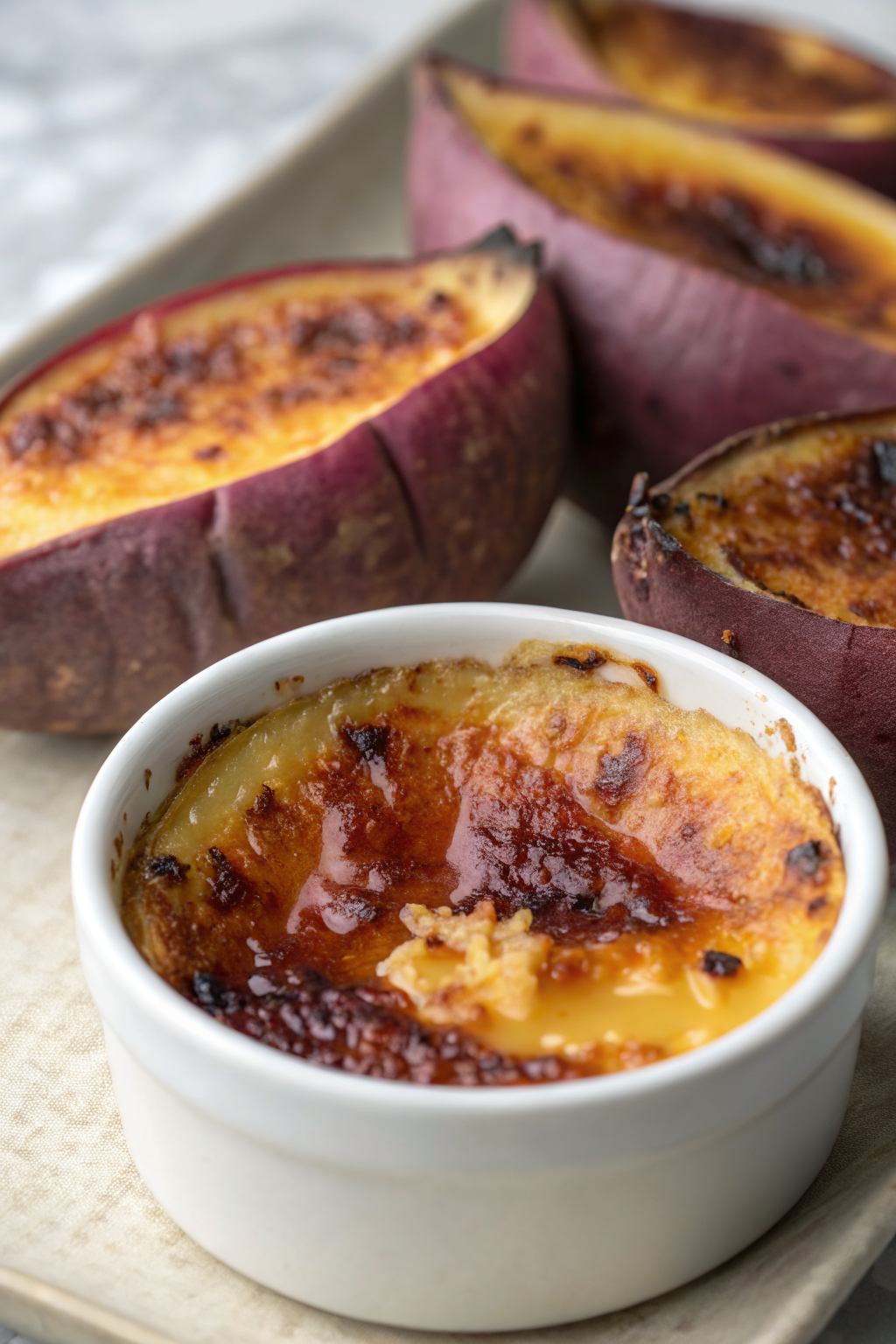
Japanese Sweet Potato Creme Brulee Recipe tastes like caramelized custard heaven with a cozy, nutty sweetness from roasted satsumaimo, and it feels richer and silkier than classic French versions. It works perfectly for dinner parties, holidays, or a quiet night when you want a fancy dessert in about 1 hour total. I tested this on my neighbors and they now “accidentally” show up whenever I roast Japanese sweet potatoes.
Why You Should Try This Japanese Sweet Potato Creme Brulee Recipe
Japanese sweet potato creme brulee tastes ultra creamy, slightly earthy, and naturally sweet, so you use less sugar than in regular creme brulee. The roasted satsumaimo adds chestnut-like flavor, which pairs beautifully with vanilla and caramelized sugar on top.
This recipe suits beginners who want a showy dessert that feels restaurant-level but uses simple steps. You mix a custard, bake it in a water bath, chill, then torch sugar until it shatters like glass.
“This Japanese Sweet Potato Creme Brulee Recipe tastes like a cozy autumn hug in a ramekin, with the perfect crackly sugar top and silky center ★★★★★”
Ingredients You’ll Need
Main ingredients
- 2 medium Japanese sweet potatoes (satsumaimo), about 1 pound total
- Look for purple skin and pale yellow flesh. They taste sweeter and drier than orange sweet potatoes.
- 2 cups heavy cream
- Use full-fat heavy cream, not half-and-half, so the custard sets rich and smooth.
- 4 large egg yolks
- Save the whites for meringues or omelets.
- 1 large whole egg
- The extra egg helps the custard hold its shape without turning rubbery.
- 1/2 cup granulated sugar, divided
- Use 1/3 cup for the custard and save the rest for the brulee topping.
- 1 teaspoon pure vanilla extract
- I like Nielsen-Massey or a good store brand; avoid imitation if possible.
- 1/4 teaspoon fine sea salt
- Salt sharpens the sweetness and deepens the flavor.
- 1/4 teaspoon ground cinnamon (optional)
- Adds warmth that pairs nicely with the sweet potato.
- Tiny pinch of ground nutmeg (optional)
- A little goes a long way, so go light.
Sugar topping
- 3 to 4 tablespoons granulated sugar
- You can mix half white sugar and half light brown sugar for a deeper caramel flavor.
Pantry shortcuts and substitutions
- Use canned Japanese sweet potato puree if you find it at an Asian market and want to skip roasting.
- Swap in regular orange sweet potatoes if you cannot find Japanese ones, but expect a slightly wetter, more pumpkin-like custard.
- Use coconut cream for part of the heavy cream if you want a subtle coconut note, but keep at least half heavy cream so the custard stays rich.
- Use vanilla bean paste instead of extract if you want visible vanilla specks and a stronger aroma.
Equipment list
- 6 to 8 small ramekins (4 to 6 ounce size)
- 1 large baking dish or roasting pan that fits the ramekins
- Kitchen torch or oven broiler for the sugar top
- Medium saucepan
- Mixing bowls
- Fine mesh strainer
- Whisk
- Measuring cups and spoons
- Baking sheet (optional, for easier transfer)
- Kettle or pot to heat water for the water bath
- Blender or food processor, or a strong immersion blender
Tips & Tricks
- Roast the Japanese sweet potatoes until they feel very soft and caramelized at the edges to get maximum sweetness and flavor.
- Cool the roasted sweet potatoes before blending so they do not scramble the eggs.
- Strain the custard through a fine mesh sieve to catch any cooked egg bits and fibers from the sweet potato.
- Tap the filled ramekins gently on the counter to pop air bubbles and get a smoother top.
- Use hot tap water or recently boiled water for the water bath and pour it into the pan after you place it in the oven to avoid spills.
- Fill the water bath so it reaches about halfway up the sides of the ramekins for even cooking.
- Bake until the custard still jiggles in the center like soft jelly, since it continues to set as it cools.
- Chill the custards for at least 4 hours or overnight so the texture turns silky and sliceable.
- Sprinkle sugar in a thin, even layer on top; thick sugar piles can burn on top and stay raw underneath.
- Move the torch constantly in small circles to caramelize the sugar without scorching one spot.
- Keep the custards cold before you torch them so the heat only melts the sugar, not the custard.
- Use a mixture of white and brown sugar if you want a deeper, toffee-like crust.
- Serve the creme brulee within 30 minutes of torching so the sugar stays crisp.
- If you use the broiler instead of a torch, chill the custards very well and place them on a cold baking sheet to protect the texture.
- Taste the sweet potato puree before mixing; if it tastes very sweet, reduce the sugar in the custard by a tablespoon or two.
How to Make Japanese Sweet Potato Creme Brulee Recipe
Step 1: Roast the Japanese sweet potatoes
- Heat your oven to 400°F (200°C).
- Wash and dry the Japanese sweet potatoes, then poke them several times with a fork.
- Place them on a baking sheet and roast for 45 to 60 minutes until they feel very soft and a knife slides in easily.
- Cool them until you can handle them, then peel off the skins and scoop the flesh into a bowl.
Step 2: Prepare the sweet potato puree
- Measure about 1 cup tightly packed roasted sweet potato flesh.
- Place the sweet potato in a blender or food processor.
- Add 1/2 cup of the heavy cream and blend until very smooth and silky.
- Scrape down the sides as needed so no chunks remain.
Step 3: Heat the cream mixture
- Pour the remaining 1 1/2 cups heavy cream into a medium saucepan.
- Add the sweet potato puree, 1/3 cup sugar, salt, cinnamon, and nutmeg if you use them.
- Whisk until the mixture looks smooth and uniform.
- Warm over medium heat until it steams and small bubbles appear around the edges, then turn off the heat and let it sit for 5 minutes.
Step 4: Mix the eggs
- In a separate bowl, whisk the 4 egg yolks and 1 whole egg until they look smooth and slightly thickened.
- Add the vanilla extract and whisk again.
- Keep whisking gently to avoid adding too much air, which can cause bubbles in the custard.
Step 5: Temper the eggs
- Scoop a small ladle of the warm sweet potato cream mixture and slowly pour it into the eggs while you whisk constantly.
- Add another ladle and keep whisking so the eggs warm up gradually.
- Once the eggs feel warm, pour the egg mixture back into the saucepan with the remaining sweet potato cream while you whisk.
- Whisk until the custard looks smooth and fully combined.
Step 6: Strain and portion the custard
- Place a fine mesh strainer over a large bowl or measuring cup with a spout.
- Pour the custard through the strainer to catch any lumps or fibers.
- Skim off any foam from the top with a spoon if you see a lot of bubbles.
- Arrange the ramekins in a large baking dish or roasting pan and divide the custard evenly between them.
Step 7: Prepare the water bath
- Heat water in a kettle or pot until it steams and small bubbles form, just below a full boil.
- Slide the baking dish with the filled ramekins onto the middle oven rack.
- Carefully pour the hot water into the baking dish so it reaches about halfway up the sides of the ramekins.
- Close the oven and bake at 300°F (150°C) for 30 to 45 minutes, depending on ramekin size.
Step 8: Check for doneness
- Start checking at 30 minutes.
- Gently jiggle one ramekin with tongs.
- Look for a set edge with a soft jiggle in the center, like gelatin, not liquid.
- When they reach that stage, remove the baking dish from the oven and lift the ramekins out of the water onto a cooling rack.
Step 9: Chill the custards
- Cool the ramekins at room temperature for about 30 minutes.
- Cover each ramekin with plastic wrap.
- Refrigerate for at least 4 hours, or overnight for the best texture and flavor.
Step 10: Caramelize the sugar topping
- When you feel ready to serve, remove the chilled custards from the fridge and pat the tops dry with a paper towel if any moisture sits on the surface.
- Sprinkle about 1 to 2 teaspoons of sugar over each custard in a thin, even layer.
- Use a kitchen torch to melt and caramelize the sugar, moving the flame in small circles until the sugar turns deep golden and glassy.
- Let the sugar cool and harden for 5 minutes, then serve.
Step 11: Broiler method option
- If you do not own a torch, place the sugared custards on a baking sheet.
- Chill them in the freezer for 10 minutes to keep the custard cold.
- Set your oven broiler to high and position a rack near the top.
- Broil the custards for 3 to 5 minutes, watching closely, until the sugar bubbles and browns, then cool for a few minutes before serving.
What to Serve with Japanese Sweet Potato Creme Brulee Recipe
Japanese Sweet Potato Creme Brulee pairs beautifully with fresh berries, especially raspberries or sliced strawberries, which cut through the richness. You can add a small dollop of lightly sweetened whipped cream and a sprinkle of toasted sesame seeds for a fun Japanese-inspired twist. Serve it after a simple teriyaki chicken dinner, a sushi night at home, or a cozy bowl of miso soup and rice. A cup of hot green tea, hojicha, or a creamy matcha latte makes a perfect non-alcoholic partner.
Storage Options
- Store leftover creme brulee in the fridge, covered, for up to 3 days before you add the sugar topping.
- Keep the ramekins on a tray so they do not slide around and disturb the custard.
- Add sugar and torch just before serving so the top stays crisp and does not soften in the fridge.
- Freeze baked custards without the sugar topping for up to 1 month, wrapped tightly in plastic and then foil.
- Thaw frozen custards overnight in the fridge, then dry the tops, add sugar, and torch.
- Avoid reheating the custards fully; serve them chilled or slightly cool so the texture stays creamy and smooth.
Japanese Sweet Potato Crème Brûlée
Ingredients
Instructions
- Preheat the oven to 300°F (150°C). Place 4 small ramekins in a deep baking dish.
- Steam or boil the Japanese sweet potato chunks until very tender, about 10–15 minutes. Drain well and let excess moisture evaporate for a few minutes.
- In a blender or food processor, combine the cooked sweet potato, heavy cream, whole milk, granulated sugar, brown sugar, vanilla, and salt. Blend until completely smooth and silky.
- In a medium bowl, lightly whisk the egg yolks just to break them up. Gradually whisk in the sweet potato cream mixture, pouring slowly to avoid cooking the yolks.
- Strain the custard through a fine-mesh sieve into a large measuring cup or bowl to remove any lumps and ensure a smooth texture.
- Divide the custard evenly among the ramekins. Skim off any foam from the surface with a spoon.
- Pour hot tap water into the baking dish to come about halfway up the sides of the ramekins, creating a water bath.
- Bake for 30–40 minutes, or until the edges are set but the centers still wobble slightly when gently shaken.
- Remove the ramekins from the water bath and let cool to room temperature, then cover and refrigerate for at least 3 hours or until thoroughly chilled.
- Just before serving, evenly sprinkle 1–1 1/2 tablespoons of granulated sugar over each chilled custard.
- Using a kitchen torch, melt and caramelize the sugar until deep golden and crisp. Let the topping sit for 2–3 minutes to harden before serving. If you do not have a torch, place the ramekins under a hot broiler for a few minutes, watching closely, until the sugar caramelizes.
Notes
Approximate per serving (1 of 4): 360 calories; fat 24 g; saturated fat 14 g; carbohydrates 31 g; fiber 1 g; sugars 26 g; protein 5 g; sodium 80 mg. Values will vary based on specific ingredients, brands, and portion size.
Leave a Reply